Nearly every home in Orlando and Central Florida sits on a concrete slab, not a crawl space or basement. That shapes every flooring decision. Concrete holds and transmits moisture, it is rarely perfectly flat, and some floors cannot be nailed to it. The right flooring for concrete slab homes depends on three things: a moisture test, the prep, and a product that suits the result. This guide walks through all three.
Why flooring for concrete slab homes needs a moisture test
Concrete looks dry, but water vapor moves up through it from the ground, especially in Florida’s high water table. If that moisture gets trapped under a floor, you get cupped wood, failed adhesive, mold under carpet pad and a musty smell. The first step on any slab job is a moisture test. Installers use a calcium chloride test or an in-slab relative humidity probe, following ASTM F710, the industry standard for preparing concrete floors for resilient flooring (ASTM F710).
Concrete must meet the selected flooring and adhesive manufacturers’ moisture, condition and preparation requirements. Slab age alone does not establish readiness. Testing and site assessment determine whether an approved mitigation system or other preparation is required.
Slab prep: flat, clean and sound
Most slabs are not flat enough for large format tile or long rigid planks without some work. We grind high spots, fill low spots with patch or self-leveling compound, and fix cracks with a filler or a crack isolation membrane. Existing adhesive, paint and unknown residues must be assessed before disturbance. Use a preparation method compatible with the selected flooring system, and resolve any required material testing before removal or encapsulation. The surface is vacuumed clean. Good prep is invisible once the floor is down, but it is the reason a floor stays quiet and flat for years.

The best flooring for concrete slab foundations
Glue-down vinyl plank
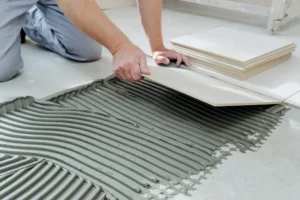
Our top pick. Glue-down LVP bonds directly to the slab, so there is no hollow sound and no movement in large rooms. It is waterproof, thin enough to meet existing tile at doorways, and easy to repair one plank at a time. For busy homes, rentals and commercial spaces, it is hard to beat. See our glue down vinyl plank page for details.
Click vinyl plank
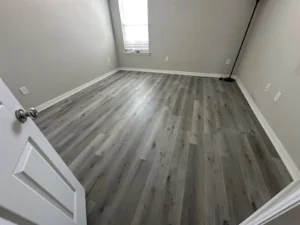
Floating rigid-core vinyl is the fastest install over a slab and needs no adhesive. It tolerates slightly higher moisture readings than wood, and many products include an attached pad. It is a great choice for bedrooms and living areas.
Porcelain and ceramic tile
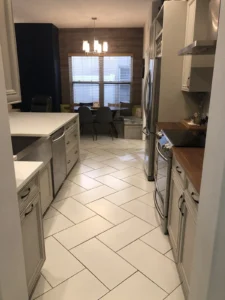
Tile and concrete are a natural pair. Tile does not mind slab moisture, and a crack isolation membrane protects it from minor slab movement. Large format and wood-look planks need the flattest prep. Our tile flooring installation page explains the process.
Engineered hardwood
Solid hardwood cannot be nailed to concrete, but engineered hardwood can be glued down with a moisture-cure adhesive, or floated over a vapor barrier. The slab must pass the moisture test first. Our engineered hardwood flooring page covers glue-down and floating installs on slabs.
Sheet vinyl
Sheet vinyl glues directly to a prepared slab and has no seams, which makes it a practical, low-cost choice for laundry rooms, utility areas and rental bathrooms.
Laminate
Laminate floats over a 6 mil polyethylene vapor barrier and underlayment. It works well in dry rooms, but it is the least tolerant of moisture, so it is not our first choice over a slab that reads high.
Carpet
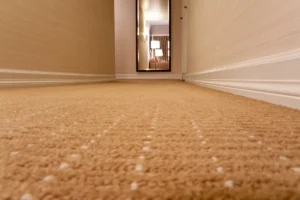
Carpet is fine on a slab with a moisture-resistant pad and a dry reading. In bedrooms it adds warmth over cool concrete, which many Florida homeowners appreciate. Avoid rubber-backed or glued carpet over a damp slab, because it traps vapor.
Flooring for concrete slab homes: quick decision guide
- High moisture reading: tile or vinyl plank, after mitigation if needed.
- Wavy slab, tight budget: click vinyl with an attached pad hides minor flaws.
- Large open plan: glue-down vinyl or large format tile for a seamless look.
- Want real wood: engineered hardwood, glued, after a passing test.
- Bedrooms: carpet or laminate may be suitable when the substrate and selected installation system meet the product manufacturers’ requirements. Do not assume a generic vapor barrier is appropriate for every carpet or laminate system.
Transitions, height and doors
Slab homes usually have existing tile somewhere, and new flooring has to meet it cleanly. Glue-down vinyl and sheet vinyl are thin, so they meet tile with a simple reducer strip. Floating floors and thick engineered wood sit higher, which can mean trimming doors and adjusting thresholds. Plan these details before ordering, because a mismatched height at a doorway is the first thing people notice. We measure every transition point during the estimate and include the trim in the quote.
Common mistakes we fix
We are often called to replace floors that failed on a slab. The usual causes are skipping the moisture test, gluing wood to a slab that was too wet, floating long planks over an unlevel floor, and using the wrong adhesive. Homeowners sometimes install over old vinyl or cutback adhesive without sealing it, which stains the new floor. Each of these is avoidable with proper prep.
FAQ: flooring for concrete slab
Can I put flooring directly over a concrete slab?
Flooring can be installed over concrete when the slab and installation system meet the selected manufacturers’ requirements. Necessary preparation, adhesive, underlayment, membranes or moisture mitigation depend on the product and measured conditions.
What flooring can go directly on concrete?
Tile, glue-down vinyl plank, sheet vinyl and glued engineered hardwood all bond directly to concrete.
What is the best flooring for a concrete slab with moisture?
Porcelain tile or rigid-core vinyl. Both are unaffected by vapor, and a mitigation primer can be added for very wet slabs.
Do I need a vapor barrier under vinyl plank?
Not for glue-down vinyl. Floating vinyl usually does not need one either, but check the product’s moisture limit and test the slab.
Not sure what your slab needs?
Orlando Flooring Gurus preps and installs over concrete slabs. We assess moisture conditions and perform testing as required by the selected flooring and adhesive manufacturers. Any required moisture mitigation will be addressed in your project scope and estimate. Book a free in-home estimate and we will explain the results and recommend the right floor. Call (321) 333-5451 or request your free slab assessment and estimate.